• Get Jeff’s Posts

  • Reach Jeff by Phone

    Got a question? Call Jeff. 774-BROWN-11 (774-276-9611)
  • Jeff’s Tweets

  • Jeff’s Blog Archives

  • Featured in Alltop
  • Jeff’s Comments

  • Disclaimer

    The opinions expressed on this weblog are my own and do not necessarily reflect those of my employer.
  • Copyright

    Creative Commons License
    If you reprint a post on this site or repost it on your own blog or website, you must include the following attribution: © 2011, Jeffery D. Brown. Used by Permission. Originally posted at thejeffbrown.me.

A Million Miles in a Thousand Years by Donald Miller: A Review

Don Miller Book CoverIf you watched a movie about a guy who wanted a Volvo and worked for years to get it, you wouldn’t cry at the end when he drove off the lot, testing the windshield wipers.  You wouldn’t tell your friends you saw a beautiful movie or go home and put a record on to think about the story you’d seen.  The truth is, you wouldn’t remember that movie a week later, except you’d feel robbed and want your money back.  Nobody cries at the end of a movie about a guy who wants a Volvo.

But we spend years actually living those stories, and expect our lives to feel meaningful.  The truth is, if what we choose to do with our lives won’t make a story meaningful, it won’t make a life meaningful either.

And so begins the new book A Million Miles in a Thousand Years: What I Learned While Editing My Life by Donald Miller, author of Blue Like JazzIn a moment, I’ll tell you how you can get a free copy. For a taste of what’s in store, as well as information on Miller’s 65-city speaking tour, interviews and more, see my previous post.

Miller asserts that a big part of living a better and more rewarding and fulfilling life is about creating meaningful stories within which to live it.  He cautions though that, The reward you get from a story is always less than you thought it would be, and the work is harder than you imagined.  The point of a story is never about the ending, remember.  It’s about your character getting molded in the hard work of the middle.

If you’re like me, you find it difficult to be motivated by words written on a page.  I don’t know why I’m wired that way.  It may explain why only in the last several years have I become an avid reader.  But despite this personal quirk, I found A Million Miles to be filled with thought-provoking and motivational moments.  One of my favorites:

I’ve never walked out of a meaningless movie thinking all movies are meaningless.  I only thought the movie I walked out on was meaningless.  I wonder, then, if when people say life is meaningless, what they really mean is their lives are meaningless. I wonder if they’ve chosen to believe their whole existence is unremarkable, and are projecting their dreary life on the rest of us.

If you’re aware change is needed but are struggling with the motivation to make that change, you might appreciate this:

Here’s the truth about telling stories with your life.  It’s going to sound like a great idea, and you are going to get excited about it, and then when it comes time to do the work, you’re not going to want to do it.  It’s like that with writing books, and it’s like that with life.  People love to have lived a great story, but few people like the work it takes to make it happen.  But joy costs pain.

He goes on to write that, because of this, we often have to force ourselves to create these stories:

We have to get up off the couch and turn the television off, we have to blow up the inner-tubes and head to the river.  We have to write the poem and deliver it in person.  We have to pull the car off the road and hike to the top of the hill.  We have to put on our suits, we have to dance at weddings.

As I read the book during a recent trip to visit my ailing grandfather, I couldn’t help but think about how little time we all have to create meaningful stories.  My grandfather, at 91, was facing the end and I, if fortunate enough to live as long, was nearly half-way there myself, I thought.  What was I going to do differently?  What changes would I make?

That was three weeks ago.  Since that time I’m glad to say that, while probably considered baby steps, I’ve begun a few new stories in my life.  Both my wife and I, if we’re not careful, can make a weekend of laying around and doing nothing (me much more so than her).  Already, we’ve discussed the need to change this habit along with specific goals toward which to shoot.  Just one example, but there are others.  Like I said, baby steps.

Meanwhile, my grandfather’s funeral is tomorrow.  And while he may be gone, I’m glad to have shared a few meaningful stories with him along the way.  The stories he fostered are what will live on beyond tomorrow.  Your meaningful stories and mine, if we choose, can begin today.

—————————————————————

Thanks to Thomas Nelson Publishers, I have a copy of A Million Miles in a Thousand Years to give away.  And if Chaffee Management comes through, I may even have several more (Update: 5 more copies for giveaway have just been made available).  For a chance at snagging one, you must take the following three actions:

  1. Leave a comment below. Tell me why you’d like this book.  I really want to know.  I might even get to know you better.
  2. Fill out this special form. I have set up a separate contact form to make it convenient for you to provide your mailing address.  Please do not include your address with your comment.  This will automatically disqualify you.
  3. Twitter a link to this post. If you don’t have a Twitter account, you can use Facebook.  Please copy and paste the following into your tweet/update:

Reading: A book review of A Million Miles in a Thousand Years by Donald Miller. @THEjeffbrown is giving away copies! http://bit.ly/oju0P

Yes, I know if more people read this, it will hurt your chances of getting a copy yourself.  But the only incentive the publisher (or author’s manager) has to provide books to giveaway is the free publicity you and I collectively provide.

On Thursday, based solely on my arbitrary and subjective evaluation of the comments, I will select a winner(s). If you are selected, I will notify you via email. If you don’t hear from me, you can assume you didn’t make the cut.

Question: Why do want a copy of this book?  What do you hope to get out of it?

Chris Brogan, Trust Agents and Social Media: Old-Fashioned Common Sense

Yesterday, I had the pleasure of sitting in on a presentation made my Chris Brogan.  Through Thursday you can purchase a DVD of the eventChristine Taylor and JTMar partnered with Stage Post Studios to not only make Chris available in person to several hundred Nashvillians, but they also streamed the event online, including incorporating questions via Twitter and by phone all in real time.  Everyone in attendance also receive an autographed copy of Chris’ new book Trust Agents, written with Julien Smith.

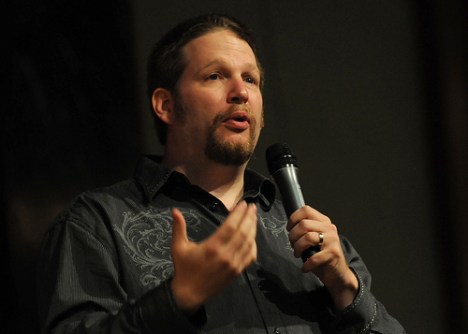
Chris Brogan

Chris Brogan, co-author of Trust Agents

Photo credit, affiliatesummit

The name Chris Brogan has become synonymous with all things social media.  Many consider him to be the authority on the subject and the single best example for individuals desiring to be viewed as thought leaders and influencers and for companies hoping to more intimately connect with customers.

Needless to say, none of us were disappointed.  However, I did find myself continually thinking, “This all sounds so familiar.”  Chris himself mentioned more than once that so much of what works in the online world is truly nothing more than good ol’ fashioned common sense.  Help other people first.

I think Zig Ziglar said it best years ago:  “You can get everything in life you want, if you can just help enough other people get what they want.”  You could even go back a little further.  Remember the Golden Rule?  To paraphrase, it says, in essence, treat other people the way you yourself desire to be treated.  Or, as Chris so succinctly puts it,  exercise some “common sense.”

Julien Smith, co-author of Trust Agents

Julien Smith, co-author of Trust Agents

Photo credit, affiliatesummit

It shouldn’t be hard, right?  Yet every day, each of us finds ourselves interacting with someone who has either failed to understand it, or understands it and is simply choosing to ignore it (maybe, heaven forbid, it’s that person in the mirror).  The best illustration I’ve ever heard that really helped to put this into perspective came from Chris yesterday.

Imagine someone you’re being introduced to for the first time has just reached out to shake your hand.  You oblige and then waste no time as you stick your tongue in their mouth.

As extreme as that sounds, it’s essentially what so many who don’t “get it” are doing every day.  How many times do you receive a friend request on Facebook (or a “follow” on Twitter or, name your platform) from someone you don’t know – and who hasn’t taken the time to even include a personal message of introduction – that is soon followed by a note about what services or product they offer that you might be interested in?

If you’ve ever chatted with someone with experience waiting tables, you’re likely to find they view the Sunday “after church” crowd as one of the worst group of tippers around (at least that’s what my anecdotal research reveals).  In some cases, the waiter or waitress is more likely to find a tract (a plan of salvation) than a tip once the table empties (just what the world needs: Christians who go around sticking their tongues in people’s mouths).

I’m embarrassed to admit that 25 years ago, as a young believer, I actually did this.  Mind you, I left a tip too, but apparently had no problem with leaving a stranger’s eternal destination up to a piece of paper.  As far as I was concerned, I’d fulfilled my obligation.  If the message didn’t sink in, that was their problem.  Investing in people’s lives was hard.  This was so much easier.  “Hurray, I planted another seed,” I told myself.

Did any of them take root?  The evidence is weak at best.  Let’s just say that if and when I get to heaven, I doubt there will be anyone eager to shake my hand.

This post is dedicated to my grandfather, William Otis Holladay, who, at 91, passed away earlier today.  A veteran of World War II, he was the epitome of common sense.  I have no doubt that in heaven, there is a long line ready to greet him.

The New Seesmic: Update Facebook Pages and Twitter Accounts From a Single App

Did I recently post I’d given up on Seesmic?  Why, yes I did.

But wait.

No sooner had I gone back to TweetDeck – and I still really like the newest version of TweetDeck – the folks at Seesmic stepped up their game and added Facebook page functionality to the interface.

As someone who manages up to four Twitter accounts and five Facebook pages at any given time, I’d longed for a third-party app that would allow me to do this.

Until now, I’d utilized  Seesmic or TweetDeck to update multiple Twitter accounts only.  When I needed to update all five Facebook pages with the same status, I leaned on Ping.fm.  With the new Seesmic, managing these accounts across separate platforms is no longer necessary.

It’ll be interesting to see if TweetDeck can respond to the call.  If you too manage multiple accounts on Twitter and Facebook, or even if you manage a single Twitter account, a single Facebook profile and a single Facebook page, this new version of Seesmic certainly seems like you’re best app option moving forward.

The New and Improved TweetDeck

Okay, so it’s a little rough around the edges (the video quality could be clearer and the audio louder), but it is, nonetheless, my first attempt at desktop video by a new service I discovered the other day called Screenr.

Here, I take a stab at explaining some of the new updates in the latest version of TweetDeck.  I left TweetDeck in May for Seesmic.  Recently though, Seesmic has begun to crash on me quite regularly.

And, while I love these new updates to TweetDeck and have switched back in large part because of them, I’m still having one relatively major issue.  Every time I open TweetDeck, none of my columns show up and I have to re-populate the application with them (frustrating to say the least).  Later today, I plan to uninstall and then reinstall the app to see if that resolves the problem.

By the way, my friend John Haydon inspired this particular video.  He happens to be a lot better at it than I am (and is also smart enough to be doing it on a Mac).

Apple’s New Nano: Radio Reinvented

If you own a DVR and have realized that watching television is an entirely new and fresh experience when you truly are in control, then have I got a product for you.

In case you missed the announcement yesterday, one of the many features of the new iPod Nano is an FM tuner.  But not just any FM tuner mind you.  Side note: I honestly think those in the industry clamoring for an FM transmitter to be added to everything from your toaster to your blow dryer are wasting their time.  The need still exists to think of your radio station beyond your terrestrial FM signal.

Having said that, I underestimated the power of a company like Apple to completely reinvent the experience.  If you’re like me and own a DVR, or listen to podcasts often, or generally appreciate the power of time shifting the content you consume, you too may have found yourself reaching for your radio dial attempting to do the impossible: rewind the feed to confirm you did indeed just hear the phrase “F hole.”

Guess what?  You can do that now.  Interrupted while listening?  Pause the song that’s playing and pick up where you left off.  If the station allows song tagging, you can even “bookmark” the song so that the next time you sync your Nano with iTunes, you can go through your list of tagged songs, preview them and purchase the ones you want.

I’ve recently begun to notice more and more the “radio is not where it’s at” montra.  If you’re an artist or a label, replacing radio as a destination for your music is not only unwise, it’s just plain dumb.   Why would you when radio listening could directly result in the purchase of one of your songs?

Don’t look now but I think listening to the radio just became cool again; for the average consumer as well as the industry.  Thanks Apple.

Am I wrong?  Do these seem like cool features to you as a consumer?  Do you like the idea of being able to pause your radio?  Rewind it?  Fast forward it?  Tag a song?  What difficulties does this present for advertisers, if any?