Guy Kawasaki (@guykawasaki on Twitter), best-selling author of The Art of the Start and Reality Check, is changing the world . And while I can’t say I always agree with his politics, I sure do love his creativity and what he brings to the world wide web.
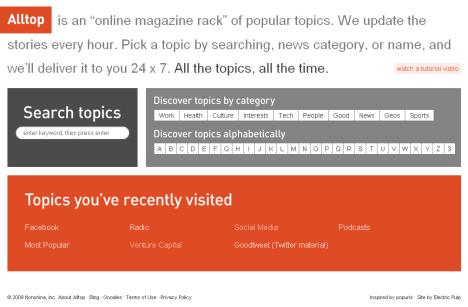
Last year he launched Alltop (inspired by popurls), a site described as an online magazine rack . Simply put, it’s a site that aggregates, in a very clean and simple way, the web’s cream of the crop from virtually every topic imaginable. There’s plenty of useful information to be found on Alltop, not the least of which is great blog post ideas.
You’ll find links to blogs and news sites on topics ranging from Acne to Zoology and virtually everything in between. Don’t find what you’re looking for? Suggest to the Alltop crew they add it by sending them an e-mail to info@alltop.com. You can even submit your own site or blog for inclusion among the topics. My blog shows up in the radio category.
Sure, there’s Google Search. And if you’re anything like me, you make use of Google Reader or another feed reader that brings your blog subscriptions right to your doorstep. So what’s so special about Alltop? Who uses it? Why? Well, Chris Brogan puts it this way:
Alltop isn’t for you or me. It’s for friends and family and coworkers who aren’t yet surfing at the speed of light with Google Reader, or adding meta commentary via FriendFeed. It’s for our neighbor who still logs into AOL, or people who want to read a sampling of information without a lot of customization.
Now, I consider myself a seasoned surfer, but I find myself often making use of Alltop anyway. Rather than doing a Google search when I’m researching a particular topic, I go to Alltop first to see if it’s covered there. If so, I instantly have a dozen or more of the top blogs on that subject at my fingertips.
Are you a Mom interested in what others in your space are writing about? Then moms.alltop.com is a good place to start. Want to learn how to make a Caramel Machiatto just like Starbucks? Try coffee.alltop.com. Looking to hone your writing skills? Check out writing.alltop.com.
Whether you’re an internet newbie or a seasoned pro, I think you’ll find plenty of benefits at Alltop.
What about you? Can you think of other ways to use Alltop?
I’ve been a participant on Twitter for several months now. In that time, I’ve read dozens of articles on how to and how not to interact within the Twitter community. It’s certainly safe to say that there are as many opinions as there are participants on how Twitter can best be utilized. And, for each individual or company who chooses to set up shop, goals can certainly vary. Heck, ask 14 people to describe Twitter and you’ll get nearly 14 different answers.
When it comes to traditional brands, a handful are content to strictly abide by the Twitter mantra, “What are you doing?” Their tweets are often a continuous stream of broadcasts. In other words, an on-going, one-way conversation. Rare are the responses, or @replies, to the questions or comments from others.
Most would agree that companies using Twitter in this way would be better off not showing up at all. No one wants a product constantly pushed in their face while at the same time feeling company X is oblivious to what’s going on around them. Thankfully, it seems more and more companies are putting a great deal of thought into their Twitter strategy.
Are You Not Entertained?
I often wonder though why similar, traditional brand behavior seems to be the rule and not the exception for many of the public figures I follow on Twitter. While I’ve been encouraged by the number of Christian musicians, authors, radio personalities and consultants I’ve discovered on Twitter, with most there doesn’t seem to be a great deal of interaction taking place between them and their followers. In fact, the sense I often get from their tweets is, “Isn’t it cool being a fly on the wall of my life?”
If you’re a public figure who uses Twitter in this way then that’s your call. And I’ll be the first to say that, for some of your fans, it might be enough. But have you ever given any thought to what it says about your personal brand?
Having said this, I realize that in the Twitterverse it’s entirely possible that those I perceive as not interacting very often with fans are indeed doing so via DM, or direct message (a message that can be sent only to people who follow you that no one else can see). Michael Hyatt (@michaelhyatt) is a good example. When he responds to a tweet from me he often does so by firing back a DM. My experience though shows that he’s likely the exception.
Engagement vs. Convenience
This limited interaction on Twitter is often coupled with another phenomenon. Most artists, authors and radio personalities I see on Twitter aren’t following even 5% as many people as are following them. In fact, many seem to be following only other people within the industry (and maybe personal friends).
When asked about it, one artist I talked to expressed the difficulty in choosing one fan over another. I wonder if some worry about being inundated with DMs from followers. There are certainly plenty of cons when it comes to DMs. How about following everyone by default, then leaving yourself the option of blocking the occasional nut case if and when necessary?
To me there seems to be a desire for the best of both worlds as long as those worlds don’t intertwine. It reminds me of the Seinfeld episode where George’s two worlds – the world of “relationship” George and that of “independent” George – threaten to do just that. George views his independent world as his sanctuary and Elaine’s decision to develop a friendship with George’s girlfriend Susan may ultimately mean the demise of that sanctuary.
I recently received an e-mail from a record label rep touting the popularity of a particular artist’s Twitter stream. According to TwitterGrader, this particular artist ranked in the top 2,000 out of over a million twitterers. Now, I don’t pretend to understand all the algorithms TwitterGrader uses to calculate their rankings, however I do know your number of followers and the power of their networks plays into it heavily. What is truly unfortunate though is that the number of people you’re following along with the frequency and quality of your engagement with them has little to nothing to do with it. Shame on Twitter.
To quote @johnhaydon from CorporateDollar.org, “On Twitter, it’s less about how many followers you have and more about the ‘health’ of your conversations with them.”
Is Twitter a passing fad? Possibly. Will it exist in even 5 years? Probably not in the same way it does today. In the meantime then, I hope this post can serve not as an indictment, but a challenge. While Twitter is in the mix and growing more popular by the day, why not make the most of it? If you see some of yourself in this post, I hope you’ll accept the challenge and venture outside your comfort zone a little more.
Twitter’s Pied Pipers?
Finally, for fear of not delivering on the title of my post, I’ve compiled a couple of lists, in alphabetical order by first name. The first is a list of those I think need to be challenged to follow more fans; fans they’ll attempt to regularly engage. Keep in mind this list is by no means exhaustive. Remember too that the opinions I’ve expressed here may in fact be mine and mine alone. If you disagree, then say so by all means. If you agree, tell me that too.
Please understand that I believe every public figure mentioned below is an absolute pro. I’m confident each and every one of them goes out of their way for their fans/readers/listeners/clients. All I’m saying is I’d like to see them take what they’re already doing in the real world and consider applying more of it to this platform. That’s all.
Some you’ll recognize as recording artists, while others are radio personalities, authors and colleagues. In each case, note their following to follower (F2F) ratio. The number of people they personally follow is first. The number of people following them is second.
I’ve noticed too that not everyone who strives to follow more than a few people is actually doing a lot of listening. Glenn Lavender of Downhere, Shaun Groves, Bryan White, Melinda Doolittle and Phil Stacey have decent F2F ratios, however, all do quite a bit more broadcasting than actual engaging, at least right now.
Lastly, here is a list of a few folks I think are doing a pretty good job of engaging and listening to their followers/fans. Again, note their F2F ratio.
Max Lucado, Charlie Lowell (Jars of Clay), Stephen Mason (Jars of Clay) and Vicky Beeching don’t follow many people relative to the number following them, but they’re interacting with others constantly. This is great to see! Natalie Grant and Mark Hall are two others I’d like to see follow more people, but recently they both seem to be deliberately interacting more. Same goes for Fee.
Still, for much of the industry, the focus seems to be on gathering more followers and not necessarly the conversations along the way. I predict that if you’ll put more effort into the engagement part of the process, at least one residual affect will be exponentially more followers. They’ll also likely be a lot more loyal and passionate about who you are and what you do than if you continue to view them as customers you can sell your message to.
One of my favorite books of the last few years is easily Pyromarketing by Greg Stielstra. In it, he outlines the four main steps in the viral marketing process.
Gather the driest tender
Light it with a match
Fan the flames
Save the coals
In this post, I’d like to highlight step two in particular. It involves the concept of lowering the barriers to trying your product. Discounting, offering samples and even giving your product away are all ways of doing this.
One real-world example involves another book and is happening as I write over at Andy Nulman’s blog Pow! Right Between The Eyes! Andy is giving away not just ten, twenty, or even 100 copies of his new book, but actually 200. In it he highlights the power of surprise in your marketing efforts.
In my industry, it can be so easy to fall back on what has worked in the past. Sticking with what’s been proven to work feels a lot safer and takes a lot less effort in the planning stages.
It is my hope that Andy’s book can help me to think more creatively and get outside my comfort zone, assuming I’m one of the 200 he decides to send a copy to. Upon reading it, I’ll review it here. Something I hope to do regularly on this blog.
If you are an author and would like me to consider your book for review, please send a review copy to:
First, it was audio recaps of “24” on the morning show. Next came the video version. You don’t even have to be a “24” fan or even watch the show to enjoy this. Brilliant!
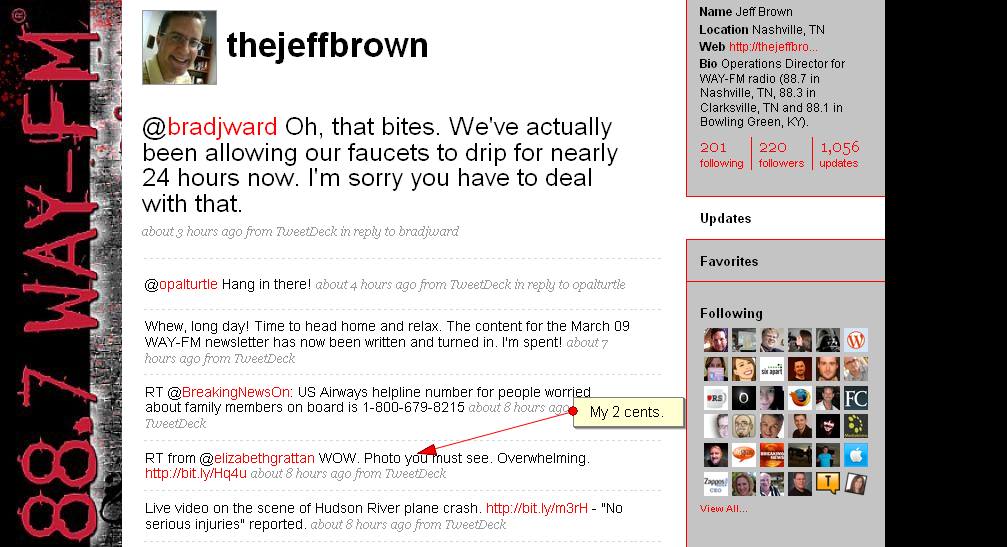
As you’ve no doubt heard, earlier today a US Airways flight, in a losing fight with a flock of geese, ended up in the Hudson River. Miraculously, not one of the 155 passengers or crew was seriously hurt.
You may have noticed, if you watched the news or read about it online, that one particular photo continued to turn up just about everywhere.
Passengers stand on the wing waiting for their turn.
The image was taken by Janis Krums on his cell phone which he then uploaded to TwitPic, a Twitter client that makes it easy to broadcast, or “tweet,” your photos. You send a picture mail to TwitPic and it automatically syncs it with your Twitter account, broadcasting a message (or tweet) based on what you put in the subject line of your picture mail, along with a shortened link directly to the image itself. Twitter, by the way, gives you a maximum of 140 characters to state your message.
In Janis’ case, he tweeted this message:
http://twitpic.com/135xa – There’s a plane in the Hudson. I’m on the ferry going to pick up the people. Crazy.
This afternoon before I left to come home from work, over 40,000 people had clicked that link – just an hour or two after it was taken. At the time I’m writing this (almost midnight) that number has more than doubled.
I’m not sure how many followers Janis began the day with (he’s at just over 2100 now), but suffice it to say, some of them “Re-Tweeted” (RT) or forwarded the above tweet, sharing it with their followers as well.
In fact, before today, I’d never heard of Janis, but one of my followers mentioned the image and the link and before I knew it, I was “tweeting” about Janis and his snapshot to all of my other followers as well.
It is utterly amazing to me how fast this kind of thing can move on a platform such as Twitter. I even heard Janis being interviewed on CNN, made popular, no doubt, by his now widely-seen photograph. According to his twitter page, he’s on MSNBC next.
Interestingly, Janis himself commented on Twitter in a post on his own blog just three days ago. In it he says:
What can you say in 140 characters or less? Can you be effective with less words? There is no room for wordiness. You need to be on point with your message as quickly as possible.
I don’t know about you, but I think he followed his own advice pretty well.
And wouldn’t you know it, just last week, I argued via Twitter with an industry colleague of mine on it’s effectiveness and future. In a direct message (DM) to me he stated:
I wonder how many people are twittering? I guess this will have jumped the shark when I see a sitcom episode around it.
Needless to say, we didn’t see eye to-eye – or should I say tweet-to-tweet – on the usefulness of Twitter. However, I believe if you’re not participating in the conversation and attempting to engage your customers and those you care about in this environment, people may soon be saying it’s your company that has “jumped the shark.”
For a great example of one company’s use of Twitter, check out @comcastcares. Their approach may not apply to your industry in every way, but I’ll bet you still find plenty of take aways.
Today is my birthday. And for the last several years, I’ve not thought of my birthday as anything to look forward to. I’ve certainly not felt comfortable drawing attention to it. Once you get to be my age, they honestly aren’t a big deal anymore – at least I thought that was the case.
In the twelve months since my last birthday, my involvement in social networks has grown tremendously. In 2008 I joined Facebook, Twitter, Plaxo, LinkedIn, FriendFeed and Vimeo, just to name a few (click any of my personal links to the right to find out more on any of these networking sites).
One of the things I appreciate most about social networking, particularly when it comes to Facebook and Twitter, is the opportunity to consistently connect with people I’d all but lost touch with before joining. Back then it took a rare e-mail or a chance meeting to catch up. On Facebook though dozens of people, many of whom I haven’t seen in years, have sent me birthday wishes.
“What’s the big deal Jeff,” you may be thinking. I know, I know, it’s a simple thing to do. I’ve done it many times myself. Your connections can literally “stumble” upon the fact it’s your birthday with no effort at all. But knowing each one took the time to send me a note has caused me to stop and think about how lucky a guy I am.
It doesn’t have to start and stop there, of course. But often times it does. And, yes, I’m as guilty as anybody. But why is that? Why are so many of us “connected” to people we’re not bothering to actually connect with on a more regular basis? Time? Too many connections to manage? Connecting to people we don’t know well?
The reasons are many, but I know one thing. One of my goals for 2009 will be to work harder at making “real” connections that I take time to cultivate, rather than connections for connections sake.
Sometimes, Mark takes the words right out of my mouth or reads my mind or says what I couldn’t quite articulate or whatever. This is one of those times.
Genius
His latest post on the future of the program director’s job delves into what I’ve been moving toward in my own position for several months now. In fact, his thoughts tie in quite nicely with my new blog’s first ever post from earlier this week.
Keep it up Mr. Ramsey and you might make even me smart one day.
I love Google Alerts. With it, I get daily e-mail updates whenever items I’m interested in show up in the news or even on individual blogs. In the example below, I’ve highlighted a daily Google blog alert I run for the search term “WAY-FM,” the name of the station for which I work.
The results don’t always turn up relevant links (like “2-way FM radios”), but that’s often simply a matter of refining the search terms a bit.
In the case of the Jasper Walls link, I’ve found a Nashville resident who is a fan of my station. Cool huh? I’ve even been able to offer a “heads-up” in the past to other operations directors within WAY-FM Media Group when a listener in their area is blogging about them.
Sincere Engagement Is The Key
Next comes the task of engaging the author (Melissa) in a transparent and meaningful way, being careful not to freak her out in the process. If not handled properly, even someone blogging to the world can “get the creeps” when being contacted immediately after mentioning you in passing.
I’ll simply thank her for listening, admit that I too sometimes “wander,” complement her on her post if it’s sincere (and in this case it certainly is), and maybe even quiz her on her favorite music and offer to send her some free stuff (a CD, t-shirt or whatever she might show an interest in).
It is my belief that sincere gestures like this can go a long way in helping create a listener for life. Plus, it’s just plain fun to do.
In my anecdotal research, I’ve found the younger the person I talk to, the higher the likelihood I find someone who doesn’t listen to the radio – at all. Most are quickly becoming accustomed to getting the content they want exactly when they want it. Radio listening, by and large, doesn’t give them that versatility.
“What about their favorite songs you say?” Their iPod satisfies that itch at a moment’s notice. Not a new idea, I know, but if your station remains nothing more than a distribution channel for music at this point, your clock has already started ticking.
If your listener’s have never heard of Pandora, they soon will. Or maybe you’re crossing your fingers hoping they remain in the dark to all these new options for customized music delivery. Well, good luck with that. Do you have plans already underway to add your station’s own streaming app to the Apple App Store? If not, why? Still waiting for Steve Jobs to add an FM tuner to the iPhone? Good luck with that too.
In the time-shifted world of Tivo, podcasts and hulu.com, terrestrial radio had better figure out a way to give listeners what they want, when they want it. First and foremost that means offering compelling content not available from anyone or anywhere else. And while content may be king, the crown is taking that content from the confines of an FM or AM signal and leveraging new, convenient and valuable-to-the-listener ways of accessing that content.
Is your station giving your listeners what they want (compelling and relevant personalities, only the great songs, reminders of not only the benefits your station offers but the values it shares with your listeners)? If so, then great. You’ve at least gotten the first step down. Are you, though, offering your listeners the opportunity to experience that content in a way that’s convenient for them, or are you limiting them to consuming only what’s coming out the speakers right now?












 Truth...Justice...All That Stuff...